
Overview
We also manage the decommissioning of downstate coal units and food processing plants in cities like Peoria and Rockford. The entire process, encompassing environmental remediation, structural wrecking, and site clearing, is handled by our experienced project managers. Strict adherence to Illinois EPA regulations is a cornerstone of our operations, ensuring that legacy contamination is properly abated. Whether preparing a warehouse for redevelopment or clearing a massive industrial tract, we provide the expertise required to safely transition these properties.
The work
Managing Environmental Abatement and Illinois EPA Compliance
Navigating the regulatory landscape in Illinois is a critical first step in any industrial teardown. The Illinois EPA mandates rigorous protocols for the handling and disposal of hazardous materials commonly found in legacy facilities. Our environmental specialists take charge of the entire permitting workflow, confirming that all necessary pre-demolition notifications, including federal NESHAP asbestos filings, are submitted without delay. Comprehensive site evaluations are conducted to pinpoint potential environmental risks, allowing us to craft tailored health and safety strategies.
Once abatement commences, our crews deploy state-of-the-art containment methodologies, such as negative air pressure enclosures, to isolate hazardous substances. Personnel are extensively trained in the safe extraction of asbestos, lead-based paints, and other regulated materials. We maintain exhaustive documentation of all waste streams and partner with third-party industrial hygienists for independent air monitoring and clearance verification.
Beyond hazardous material management, our environmental commitment includes robust recycling initiatives. We actively divert massive quantities of concrete, structural steel, and masonry away from local landfills. On-site concrete crushing operations produce engineered fill that can be reused during the site's subsequent redevelopment phase.
Method and sequence
Teardown of Chicago-Area Steel Plants and Refineries
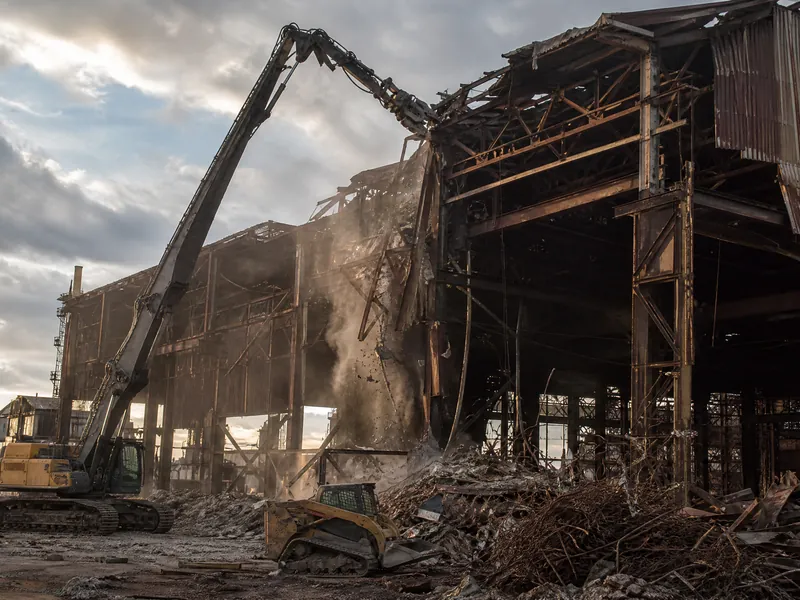
The concentration of heavy industry in the Chicago region and its southern suburbs presents unique structural challenges. Dismantling massive steel finishing facilities and complex petrochemical refineries requires specialized heavy equipment and precise engineering. Our operators utilize high-reach excavators equipped with hydraulic shears to systematically dismantle blast furnaces, coking structures, and heavy-wall process piping.
Before the heavy wrecking equipment is mobilized, all plant utilities must be completely isolated and de-energized. Process lines are meticulously purged of residual chemicals to eliminate potential hazards. This critical preparatory work ensures that the subsequent structural demolition can proceed safely and efficiently, protecting both our personnel and the surrounding community.
Asset recovery is integrated directly into our teardown methodology. We carefully segregate high-value ferrous and non-ferrous metals during the dismantling process. These materials are processed on-site and shipped directly to mills, generating a salvage credit that significantly offsets the client's overall project cost.
Local coverage
Cities we work in across Illinois
Hazards and controls
Retiring Downstate Coal Infrastructure
The ongoing transition of the energy sector has led to the retirement of numerous coal-fired generating units across downstate Illinois. These sprawling complexes feature towering exhaust stacks, massive boiler houses, and extensive coal handling systems. Executing the safe collapse or methodical dismantling of these structures demands rigorous planning and advanced rigging techniques. Our project managers engineer detailed demolition sequences that account for the degraded structural integrity of aging power plant components.
Dust suppression is a major focus during the demolition of coal silos and ash handling facilities. We employ high-capacity water cannons and localized misting systems to control airborne particulates at the source. These measures ensure that our operations remain in strict compliance with local air quality standards and minimize any impact on neighboring properties.
Extracting maximum value from retired energy assets is a key priority. We identify and carefully remove valuable components such as turbines, large generators, and transformers. The market value of these recovered items is applied as a salvage credit, improving the financial dynamics of the decommissioning project.
Sequence of work
How a project runs, stage by stage
Site walk and survey
We walk the structure with you, review drawings, and record structural condition, live utilities, hazardous materials and salvageable assets before any number is quoted.
Engineering and permits
An engineered demolition plan sets the sequence, exclusion zones and means of collapse. We file local permits and the federal pre-demolition notification, and collect utility isolation sign-offs.
Abatement and pre-clean
Regulated materials come out first under containment with clearance documentation, so the structural phase is never held up by a surprise inside a wall or a pipe chase.
Dismantling and teardown
High-reach machines, shears, torch crews and hand demolition work the sequence top-down or inside-out, with salvage separated as it comes out rather than picked from a mixed pile afterwards.
Processing and haul-off
Steel is sheared and shipped, concrete is crushed for reuse or hauled, and every regulated stream leaves under manifest to a permitted facility.
Grading and closeout
Foundations and slabs come out to the agreed depth, the site is graded and stabilised, and you receive manifests, clearance reports and closeout documentation.
Permits and notification
Urban Logistics and Material Transport Strategies
Coordinating the movement of heavy equipment and processed scrap across Illinois requires a flexible logistical approach. The dense urban environment of Chicago contrasts sharply with the expansive industrial sites found in Granite City or Rockford. We capitalize on the state's extensive transportation network, utilizing major interstates, rail spurs, and river access to optimize material flow.
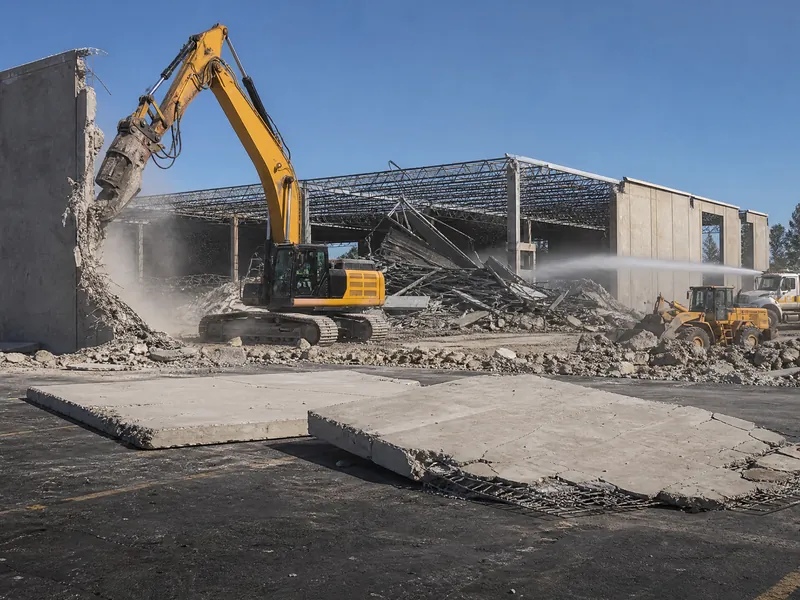
Operating within tight urban footprints often necessitates selective interior demolition techniques. Our crews are skilled at removing mechanical systems and architectural features while leaving the building shell intact, a strategy frequently employed for the adaptive reuse of warehousing and distribution centers. Strict traffic control and the use of compact machinery allow us to work safely in constrained spaces.
When projects are located near the Illinois River or major rail corridors, we leverage multi-modal transport options. Loading processed scrap metal directly onto barges or railcars significantly reduces freight expenses and accelerates the clearing of the site.
Salvage and recovery
Finalizing the Site for Future Development
The ultimate goal of our demolition services is to deliver a clean, stabilized site ready for its next purpose. Following the removal of all above-grade structures, our attention shifts to the extraction of subterranean elements. Heavy excavators equipped with hydraulic breakers are used to fracture massive concrete foundations, footings, and underground utility vaults. This thorough clearing process ensures that no hidden obstructions remain to complicate future construction efforts.
Proper site grading is essential for long-term stability. We carefully contour the land to facilitate natural drainage and install erosion control measures to protect the property from weather-related damage. A comprehensive final walkthrough is conducted with the client to verify that all project specifications have been met.
At the conclusion of the project, we provide a detailed closeout package. This documentation includes all finalized permits, environmental clearance reports, and waste disposal manifests, serving as a permanent record of regulatory compliance and facilitating the smooth transfer of the property.
Common questions
Questions owners and engineers ask
What permits are required for industrial teardowns in Illinois?
Securing the necessary approvals involves coordinating with the Illinois EPA and various local agencies. A mandatory 10-day waiting period applies to the federal NESHAP asbestos notification before any structural dismantling can commence. For complex industrial sites, the permitting process may require extensive environmental assessments and detailed abatement plans. We handle all regulatory filings and engage with authorities early in the planning phase to ensure that permits are secured without delaying the project schedule.
How is the salvage credit determined for my project?
The salvage credit is a direct offset applied against your total demolition cost. As we dismantle your facility, we recover recyclable materials like structural steel, heavy machinery, and copper wiring. We calculate the current market value of these assets and deduct that amount from the gross expense of the teardown. This financial structure ensures that we are highly motivated to maximize the recovery and processing of valuable materials throughout the duration of the project.
Who takes care of disconnecting the plant's utilities?
Typically, the facility owner is tasked with contacting local utility providers to terminate services at the property boundary. Inside the plant footprint, however, our crews manage all utility isolation and de-energization. We physically air-gap electrical connections, cap gas and water lines, and purge all process piping. We mandate written confirmation that all utilities have been successfully disconnected before we mobilize any heavy wrecking equipment to the site.
What measures are taken to control dust during the project?
Suppressing airborne particulates is a fundamental part of our environmental compliance program. We utilize high-capacity water cannons, localized sprayers, and misting systems directly on our concrete crushing and structural wrecking equipment. These site-specific dust control strategies are engineered to meet or exceed Illinois EPA requirements, ensuring that our operations do not negatively impact surrounding areas or violate local emission standards.
What kind of documentation will I receive when the work is done?
Upon completion, you will receive a comprehensive closeout package that documents the entire demolition and remediation process. This includes all approved permits, NESHAP filings, and clearance reports from independent environmental hygienists. We also supply detailed waste manifests and weight tickets for all materials transported off-site, covering hazardous waste, general debris, and recycled metals. This complete record is vital for proving regulatory compliance and preparing the site for future use.
Ready to price the teardown?
Industrial Demolition USA executes highly engineered dismantling and asset recovery projects for complex industrial sites across Illinois. Our dedicated teams oversee every aspect of the teardown, from initial environmental abatement to final site stabilization. Reach out to us at 954-740-1983 or email electricalequipmentbuyers@gmail.com to review your upcoming facility retirement.