
Overview
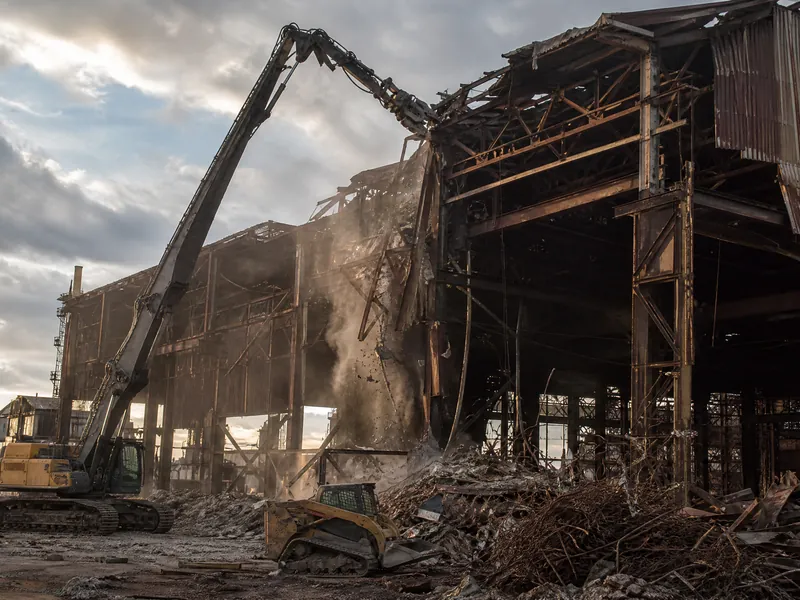
Minneapolis jobs demand careful access planning because active streets, adjacent businesses, buried utilities, and redevelopment pressure leave little room for error. Our team manages abatement, teardown sequencing, salvage, and site clearing so owners can retire obsolete assets without turning the project into an open-ended risk item.
The work
A Dense Urban Industrial Environment
Minneapolis industrial demolition is shaped by urban density as much as by the building itself. Riverfront properties, older warehouse districts, and inner-city manufacturing parcels often sit close to active roads, occupied buildings, and live utility infrastructure. Many structures also carry legacy conditions from multiple remodels, process changes, and additions that make a simple machine-driven wrecking plan unrealistic.
That is why we approach city work as controlled dismantling first and production demolition second. Food and beverage facilities, former mill properties, steam plants, and distribution buildings may require interior strip-out, floor opening protection, overhead separation, and staged access zones before larger equipment can start the structural phase. Tight logistics are part of the job, not an exception.
Method and sequence
Controlling Dust, Vibration, and Public Exposure
Owners in Minneapolis usually need more than a demolition crew and a haul route. They need a contractor that can control dust, traffic interfaces, vibration, noise, and debris exposure near the public. We set up fencing, machine zones, wetting plans, truck movement patterns, and debris handling procedures that fit an active urban setting rather than relying on wide-open rural assumptions.
These controls matter on redevelopment parcels and along busy corridors where neighboring tenants, sidewalks, or service alleys remain active. Selective demolition, smaller machine work, and sequenced structural drops can reduce risk when compared with rushing large sections of the building at once. Public protection and schedule protection usually point to the same answer: slower in the right place, faster where the site can safely absorb it.
Hazards and controls
From Utility Cutoff to Final Slab Work
A typical Minneapolis industrial project begins with utility verification, lockout support, de-energisation, and hazardous material planning. After that, our crews perform abatement and interior deconstruction to remove regulated materials, process residue, suspended mechanicals, and nonstructural obstructions. Only then do we advance into exterior structural demolition using excavators with shears, grapples, breakers, and loaders sized to the access envelope.
Once above-grade work is finished, we address pits, machine pads, slabs, and below-grade obstructions. Some sites require selective foundation removal so the next builder can reuse parts of the subgrade, while others need full clearance and rough grading. By linking decommissioning, demolition, and remediation in one sequence, the owner gets a site that is actually ready for the next phase instead of just partially knocked down.
Permits and notification
MPCA Compliance and City Coordination
State and local approvals are a real part of the Minneapolis timeline. We account for MPCA-related environmental steps, local demolition permits, and the federal NESHAP asbestos notification requirement before structural teardown begins. Depending on the parcel, the work may also require coordination around traffic control, utility confirmations, erosion measures, or adjoining property conditions that cannot be solved after mobilization.
Our role is to connect the paperwork to the field plan. We work with owners and consultants on surveys, regulated material sequencing, disposal profiles, and documentation of waste streams. That reduces the chance of a shutdown caused by a missed filing or a conflict between the demolition schedule and the approved environmental path.
Salvage and recovery
Material Recovery in the Twin Cities Market
Minneapolis properties often contain valuable recovery streams if they are dismantled cleanly. Structural steel, stainless equipment, copper, aluminum, cable, switchgear components, and process metals can often be separated before mixed debris handling begins. Concrete and masonry may also be processed or hauled to regional outlets depending on contamination, site size, and redevelopment plans.
We apply eligible recovery value as salvage credit against the demolition contract. That approach fits clients managing retirements across the Twin Cities and beyond, including related work in St. Paul, Duluth, and Rochester. The focus remains contractor-performed demolition and asset recovery, with clear documentation of what was removed, recycled, disposed, and left ready for the next contractor on site.
Capabilities
Abatement, remediation and recovery
Common questions
Questions owners and engineers ask
What usually makes an industrial demolition project in Minneapolis more expensive?
Urban access limitations, heavier public protection measures, abatement scope, traffic control, foundation depth, and off-site haul demands are common cost drivers. Older riverfront and inner-city sites often take more planning than newer suburban industrial buildings because there is less room to work.
Can demolition proceed while parts of the property remain active?
In many cases, yes, but only with proper separation. We can stage selective demolition, utility isolation, and structural work around occupied or still-operating portions of a site when the building layout and safety controls support that approach.
Who handles asbestos and other regulated materials?
Those materials are addressed early in the sequence through surveys, abatement planning, and regulated removal before structural wrecking begins. We coordinate that work with the required notification timeline so the field crew is not forced to stop once demolition equipment is already mobilized.
How is salvage value treated on a Minneapolis project?
Recoverable material value is treated as a salvage credit applied against contract cost when the structure contains marketable metal or equipment components. The amount depends on separation quality, contamination, loading efficiency, and prevailing market conditions during removal.
What does closeout include after the site is cleared?
Closeout typically includes documentation for disposal and recycling streams, manifests where applicable, and confirmation of grading or site clearing work in our scope. On redevelopment parcels, that recordkeeping helps the owner hand the site to the next team with fewer unanswered questions.
Ready to price the teardown?
When you need an industrial demolition contractor in Minneapolis, Industrial Demolition USA can map the sequence from abatement through final clearing. Call 954-740-1983 or email electricalequipmentbuyers@gmail.com to review your Minneapolis demolition scope.